
Guides
FODMAP Stacking: What It Means and When It May Matter
FODMAP stacking may help explain why a mixed meal is tolerated differently from its individual foods. Learn what stacking means, what it does not mean, and how to avoid unnecessary restriction.


A food can seem comfortable in one context and be followed by symptoms in another. Portion size, the rest of the meal, stress, sleep, illness, menstrual-cycle changes, meal size, and normal IBS variability can all affect what happens next.
FODMAP stacking is one possible explanation when symptoms occur after a mixed meal. It is not the default answer, and one difficult meal cannot confirm that stacking was responsible.
What FODMAP stacking means
FODMAPs are fermentable carbohydrates that are absorbed incompletely in the small intestine. They can draw water into the bowel and are fermented by gut microbes, which can contribute to symptoms in some people with IBS.
Monash University uses "FODMAP stacking" for the total amount of FODMAPs eaten in one sitting or meal. A meal may contain fructans, excess fructose, lactose, galacto-oligosaccharides (GOS), or polyols from several foods. The combined amount in that eating occasion can influence tolerance, even when no single ingredient seems like an obvious explanation.
Monash says its green-serving cut-offs are conservative and are designed to allow more than one green serving in a meal. Most people do not need to count every FODMAP or avoid combining green servings. Consider stacking only if a low-FODMAP approach has already improved most symptoms but some symptoms remain.
Stacking is mainly a meal-level idea, not a running total that inevitably builds across the whole day. If eating occasions are very close together, the boundary between them may be less clear for some people. That does not create a universal reset time or prove that an earlier food caused later symptoms.
A plain-English meal example
Imagine a meal containing several foods that each contribute some FODMAPs at the portions eaten. The total FODMAP amount in that meal may be higher than the amount from any one item alone. That makes the combination worth considering if symptoms repeatedly follow similar meals, but it does not identify which ingredient or mechanism was responsible.
Serving size matters. A food can have a green rating at one portion and an amber or red rating at a larger portion in the Monash app. Check the tested serving for the amount actually eaten rather than treating a food as permanently "safe" or "unsafe."
Why the idea is easy to overapply
The term "FODMAP stacking" does not appear in the scientific literature as a diagnosis. Monash bases the concept on research in which combined FODMAP exposure caused more symptoms than one FODMAP alone, together with evidence that reducing FODMAPs collectively can improve symptoms for some people with IBS.
There is no evidence-based rule that symptoms begin after a particular number of moderate-FODMAP foods. Individual tolerance varies, portions matter, and Monash's green thresholds already allow combinations. Counting ingredients without checking their portions can make an ordinary varied meal look riskier than it is.
Situations where meal-level load may be worth reviewing
- A larger portion than the tested green serving, including a recipe that quietly doubles or triples the portion
- Several amber or red servings in one sitting, whether they contain the same or different FODMAP types
- Restaurant or prepared meals with uncertain portions, especially when onion, garlic, wheat, legumes, dairy, fruit, or polyol sweeteners appear together
- Meals and snacks eaten very close together, if this pattern repeatedly accompanies symptoms for you
How to review a possible pattern without tightening your diet
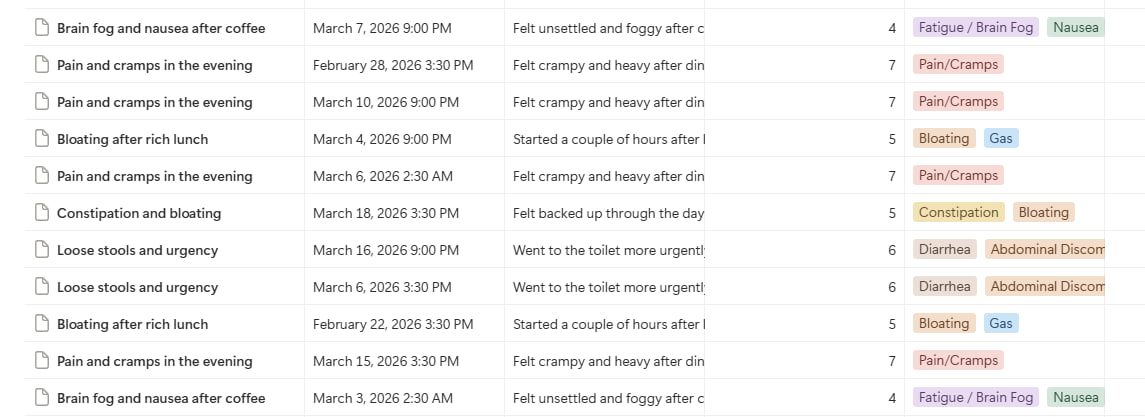
Do not start monitoring stacking if your symptoms are already well controlled. If symptoms remain despite an appropriately guided low-FODMAP approach, a simple record can help you and a registered dietitian review whether portions and mixed meals deserve attention.
- Record the whole meal, including sauces, drinks, snacks, and approximate portions
- Check serving-size ratings in a current, evidence-based FODMAP resource
- Note symptoms without assigning a cause from one episode
- Record major alternative explanations such as stress, sleep, illness, alcohol, menstrual-cycle changes, and unusually large meals
- Compare repeated situations and keep mixed or inconsistent results uncertain
A diary can show a possible association, not diagnose the cause. Bring the record to a FODMAP-trained registered dietitian rather than inventing stricter food rules or deliberately combining foods to provoke symptoms.
If you are in the restriction or reintroduction phase, follow the portions and schedule in your professional plan. Our cautious reintroduction guide explains why one planned variable at a time is easier to interpret and why uncertain results should remain uncertain.
Keep the long-term goal broad and varied
Understanding stacking should not mean staying strictly low FODMAP or removing more foods. Monash describes a three-step diet: a short restriction phase, structured reintroduction, and personalisation. The long-term goal is to relax restrictions as much as possible and include a varied diet based on individual tolerance.
If reviewing stacking makes you anxious about combining foods, leaves you skipping meals, or keeps narrowing your diet, pause and seek help from a registered dietitian. NICE recommends that exclusion diets such as low FODMAP be advised by a healthcare professional with expertise in dietary management.

Keep the whole meal in view
Log meals, portions, symptoms, and relevant context in one place, then review possible patterns without treating an association as proof.
Start Tracking Free →When stacking is not the right framework
IBS symptoms can vary because of stress, sleep, illness, medications, hormonal changes, meal size, eating pace, and other gastrointestinal conditions. New, changing, persistent, or severe symptoms deserve medical assessment rather than another layer of dietary restriction.
FODMAP stacking is an IBS symptom-management concept, not a way to assess food allergy. Do not deliberately retry a food if you suspect an allergy. Hives or another suspected allergic reaction warrant clinical advice rather than a food challenge.
Sudden swelling of the mouth, tongue, or throat, difficulty breathing or swallowing, severe dizziness or confusion, or fainting can signal anaphylaxis. Use an adrenaline auto-injector if prescribed and call your local emergency number immediately. A rash can accompany anaphylaxis, but do not wait for one before seeking emergency help.
FODMAP stacking describes the possible additive effect of FODMAPs eaten in one sitting. It may matter for some people, but green servings are designed to be combined, there is no universal ingredient threshold, and stacking is not a whole-day tally or a diagnosis. Review portions and repeated meal patterns without sacrificing variety or making restrictions stricter on your own.
Sources
- Monash FODMAP: FODMAP Stacking Explained, including meal-level scope, conservative green cut-offs, and individual variability
- Monash FODMAP: The three-step diet and dietitian guidance
- NICE: Irritable bowel syndrome in adults, dietary management recommendations
- NHS: Food allergy symptoms and clinical advice
- NHS: Anaphylaxis signs and emergency action


This article is for informational purposes and is not medical advice. Talk to your doctor before making dietary changes.
Start with the free 7-Day Trigger Discovery Challenge
Not ready for the app yet? Download the printable guide and work through 7 days of structured observation, with a few practical follow-up emails to help you stay on track.
- 20-page guide delivered immediately by email
- Daily meal, symptom, and lifestyle tracking pages
- Designed to help you spot early trigger patterns without overwhelm
Free - delivered straight to your inbox
🔒 No spam, we promise. Unsubscribe any time.
Or skip straight to the app - start tracking free →
Ready to find your triggers?
Track by voice. Let AI surface possible patterns.
Log meals and symptoms in seconds. AI structures your data and surfaces possible patterns, including delayed associations worth testing.
Start Tracking Free →Free to start · $59 one-time for full insights · No subscription