
Tracking
Keeping a Bloating Diary: What to Track and Why
Learn what to record in a bloating diary so you can review possible food, timing, bowel, and context patterns without treating a diary as a diagnosis.


"I feel bloated" records a real symptom, but it leaves little to compare later. It does not show whether the feeling was pressure, fullness, pain, or visible swelling, what else was happening that day, or whether the same situation had occurred without symptoms.
A bloating diary adds that missing context. It can help you and a clinician compare episodes, notice possible associations, and decide what deserves a closer look. It cannot diagnose the cause of bloating or prove that a particular food caused an episode.
A general food diary can be useful, but a few bloating-specific fields make the record easier to interpret. Here is what to capture and how to avoid reading more certainty into the diary than it can support.
Why bloating needs more than a food list
Bloating is the feeling of fullness or swelling in the abdomen. Visible enlargement is called abdominal distension, and the two do not always occur together. Recording them separately gives a clinician a clearer description of what you experience.
Possible contributors include swallowed air, undigested carbohydrates reaching bacteria in the large intestine, constipation, food intolerances, celiac disease, IBS, and other digestive conditions. Some people also notice bloating around their period. Because several factors may overlap, an entry such as "ate pasta, felt bloated" cannot distinguish among them.
Gas odor does not identify the responsible food or diagnose the cause. If gas is part of the episode, record it as another symptom rather than using smell or volume to decide what happened.
If you have not read our overview of how to track food triggers yet, that is a useful foundation. This guide focuses on the extra detail that can make a bloating record more useful in a clinical conversation.
Seven useful fields for a bloating diary
1. When the episode began
Record the approximate time bloating started and what you had eaten or drunk beforehand. Timing can help organize the history, but there is no single onset window that reliably separates swallowed air, fermentation, food intolerance, constipation, or another cause. Do not use a fixed time window to declare one meal responsible.
2. What the symptom felt and looked like
Note pressure, fullness, discomfort, pain, or visible distension. If practical, record whether clothing felt tighter or your abdomen looked different, but avoid repeatedly measuring or photographing yourself if that increases anxiety. The aim is a useful description, not perfect surveillance.
3. Severity on one consistent scale
Choose a simple scale, such as 0 to 10, and use the same anchors each time. A home rating is subjective and is not a diagnostic score, but consistency can make one person's episodes easier to compare over time.
4. The complete meal and rough portions
Record the main ingredients, drinks, and rough portions instead of only naming the largest item. Portion and meal composition may matter, and mixed meals create confounding. One episode after a meal is not enough to identify a food as the cause.
For people with medically diagnosed IBS who are already using a low-FODMAP plan, total FODMAP intake in a meal may sometimes matter. That does not mean every mixed meal is a "FODMAP stack" or that you should begin broad restriction from diary data alone.
5. Eating and drinking context
Note whether you ate quickly, had a fizzy drink, chewed gum, or were talking while eating. Eating or drinking quickly, carbonated drinks, and some other habits can increase swallowed air. Record these as possible context, not as proof of what caused the symptom.
6. Bowel habits and other digestive symptoms
Record constipation, diarrhea, bowel movements, abdominal pain, nausea, or vomiting around the episode. Constipation can contribute to bloating and may change what a clinician evaluates or treats. Missing information should remain unknown rather than being treated as a symptom-free day.
7. Menstrual-cycle and stress context, if relevant
Some people notice bloating around their period, and IBS symptoms can be influenced by brain-gut interactions. A diary can show that episodes coincide with a particular context, but an observational pattern cannot prove that hormones or stress caused the bloating.
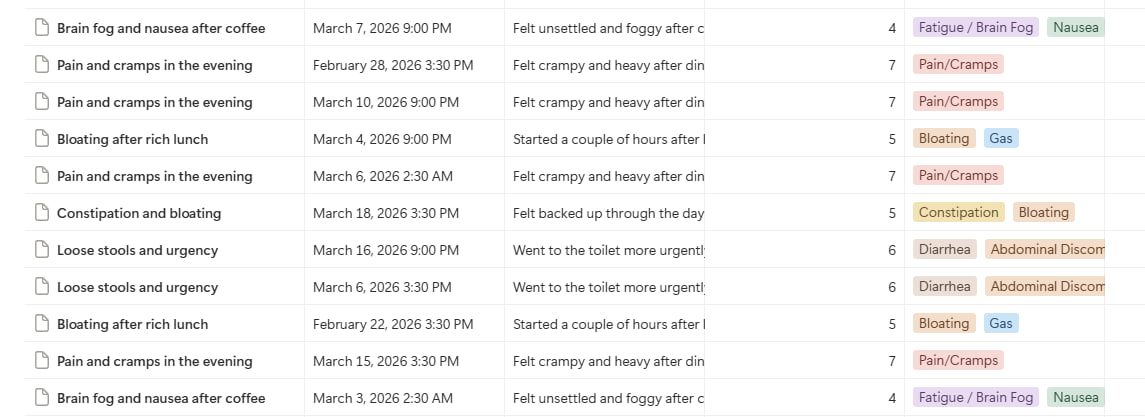
A simple template to start with
- Date and approximate time of the episode
- Pressure, fullness, pain, visible distension, or a combination
- Severity on the same scale each time
- Foods, drinks, rough portions, and meal time
- Eating pace, fizzy drinks, gum, or other swallowed-air context
- Bowel movement and stool context that day
- Other symptoms, medicines, supplements, illness, stress, or cycle context
- What is unknown or was not recorded
You do not need to complete every field perfectly. A short entry recorded consistently is often more useful than a detailed form you stop using. Voice or text notes can reduce the effort.
How to review the diary without overinterpreting it
Review groups of entries rather than blaming the most memorable meal. Ask:
- Did the same exposure appear before several episodes?
- Were there also times you had that exposure without bloating?
- Did several foods, portions, bowel changes, medicines, or stressful events occur together?
- Are symptom-free days documented, or is the comparison data missing?
- Is the pattern consistent enough to discuss with a clinician or registered dietitian?
Repeated observations may identify a possible association worth discussing or testing carefully, but coincidence and confounding can remain. Do not use the diary to diagnose IBS, food intolerance, celiac disease, or food allergy.
If you are considering a low-FODMAP diet or another substantial restriction, work with a clinician or registered dietitian. A low-FODMAP diet is a structured, temporary process for medically diagnosed IBS, followed by reintroduction and personalization. It is not a permanent list of foods to avoid.
Our guide to bloating after eating explains why the symptom can have several overlapping contributors.
Keep bloating notes easier to review
Log meals, portions, symptoms, bowel context, and timing by voice or text. Find My Triggers organizes entries to help you review possible associations, not diagnose a cause.
Start Tracking Free →When to seek medical help
See a clinician if bloating is frequent, persistent, worsening, or affecting daily life. Arrange medical review if it occurs with unintentional weight loss or blood in the stool. Bloating with vomiting, diarrhea, constipation, fever, abdominal pain, or a new abdominal lump may need more urgent advice.
Get emergency help for severe abdominal pain that starts suddenly, vomiting blood, severe breathing difficulty, or a swollen abdomen when you cannot pass urine, stool, or gas. Do not use a diary to delay urgent care.
A useful bloating diary records the symptom itself, complete meals, portions, timing, bowel habits, and relevant context. Review repeated exposures alongside symptom-free exposures and unknown days. Treat any pattern as a hypothesis for a clinician or dietitian discussion, not a diagnosis or confirmed trigger.
Sources
- National Institute of Diabetes and Digestive and Kidney Diseases: Symptoms and causes of gas in the digestive tract
- National Institute of Diabetes and Digestive and Kidney Diseases: Diagnosis of gas in the digestive tract
- American Gastroenterological Association Clinical Practice Update on belching, abdominal bloating, and distension, 2023
- NHS: Bloating, including causes and when to seek help
- Monash FODMAP: FODMAP stacking explained
- Monash FODMAP: The three-step low-FODMAP diet and dietitian guidance



This article is for informational purposes and is not medical advice. Talk to your doctor before making dietary changes.
Start with the free 7-Day Trigger Discovery Challenge
Not ready for the app yet? Download the printable guide and work through 7 days of structured observation, with a few practical follow-up emails to help you stay on track.
- 20-page guide delivered immediately by email
- Daily meal, symptom, and lifestyle tracking pages
- Designed to help you spot early trigger patterns without overwhelm
Free - delivered straight to your inbox
🔒 No spam, we promise. Unsubscribe any time.
Or skip straight to the app - start tracking free →
Complete Tracker Kit - $29
The IBS Tracker Kit - Notion, Sheets & Printable
Everything you need to start tracking: Notion tracker, Google Sheets tracker, printable 30-day journal, FODMAP reference card, elimination diet protocol, and free AI analysis of your data.
Get the Tracker Kit →$29 one-time · Notion + Sheets + Printable · Free AI analysis included