
Tools
IgG Food Sensitivity Tests: What the Science Actually Says
IgG food sensitivity test accuracy is a common search for good reason, the results are confusing. Here's what IgG antibodies actually measure.


A blood test that measures antibodies against specific foods sounds like it should work the way an allergy test does: high number, real problem. It is a reasonable assumption, but it is not how IgG testing works. Understanding why changes how the entire category of consumer intolerance tests should be interpreted.
If you've searched for "IgG food sensitivity test accuracy," you've probably already sensed something is off, maybe from a confusing report, maybe from a friend who tested "positive" for foods they eat every day with zero symptoms. Here's what's actually going on.
What IgG antibodies are for
IgG is one of several classes of antibodies your immune system produces. Unlike IgE, the antibody class responsible for classic allergic reactions, IgG is not primarily a threat-response antibody. It's involved in long-term immune memory, and producing IgG against a food protein is a normal, expected part of your immune system's routine response to something you eat regularly.
Some research has proposed that higher IgG4 levels specifically may actually reflect immune tolerance to a food rather than a problem with it. That's a notable contrast to how consumer test reports typically present a high IgG result, which is usually flagged as "reactive" in red.
In practice, this means the foods most likely to show up "positive" on an IgG panel are the foods you eat most often, dairy, wheat, eggs, common proteins, regardless of whether they cause you any symptoms at all.
Why this is different from allergy testing
True IgE-mediated food allergy testing (skin prick tests or specific IgE blood tests) measures a different, well-characterized immune pathway that's been validated against clinical outcomes. When someone has a true allergy, elevated IgE against that food correlates with real, observable, sometimes dangerous reactions, and the tests have decades of clinical validation behind them.
IgG testing has no equivalent track record for diagnosing intolerance or sensitivity. The two get marketed in similar-looking packaging (a vial of blood, a lab report, a list of foods), which is part of why people reasonably assume they work the same way. They don't. I cover the broader allergy-versus-intolerance distinction in more depth in Food Sensitivity vs Food Allergy: What's the Difference?
Where the professional bodies stand
This isn't a fringe opinion. The American Academy of Allergy, Asthma & Immunology (AAAAI), a leading US professional body for allergists and immunologists, publishes patient guidance directly addressing this, titled "The Myth of IgG Food Panel Testing." Their position is that food-specific IgG is a marker of exposure, not a diagnostic tool for food allergy or intolerance, and that testing it for this purpose isn't supported by evidence. This aligns with the "Choosing Wisely" campaign, in which allergy specialty societies specifically advise against unproven IgG-based testing in the evaluation of allergic and intolerance-type conditions.
If you've had a genuine allergic-type reaction (hives, throat or lip swelling, wheezing, or any reaction that felt dangerous), that needs evaluation with a validated IgE allergy test and a clinician, not a consumer IgG panel. Don't substitute one for the other.
So why do people feel better after an IgG-guided elimination?
This is the part that keeps the tests popular, and it deserves an honest answer rather than a dismissive one. People often do feel somewhat better after removing everything flagged on an IgG report. A few real mechanisms explain that without validating the test itself:
- Removing 15 to 30 foods usually means removing a lot of processed food, added sugar, and alcohol along the way, which can genuinely reduce symptoms for unrelated reasons
- Eating a smaller, more repetitive diet naturally reduces variety-driven fermentation load
- Placebo and expectation effects are well documented and real, particularly for subjective symptoms like bloating and fatigue
- By chance, a food you actually do react to might be among the ones removed, buried among a dozen others you didn't need to cut
None of that tells you which specific food, if any, contributed to the improvement, which is usually the question people hoped the test would answer.
What a positive result would need to show, and doesn't
For a test to be diagnostically useful, a positive result needs to reliably predict who has the condition and a negative result needs to reliably predict who doesn't, ideally confirmed against a proper reference standard like a blinded food challenge. IgG panels haven't demonstrated that relationship in the research literature. Positive results are common in people without any symptoms at all, and repeat testing on the same person, on the same food, doesn't reliably reproduce the same result. That combination, high positive rates unrelated to symptoms plus poor test-retest consistency, is exactly what you'd expect from a marker of ordinary food exposure rather than a marker of disease, and it's the core reason allergy and immunology bodies don't recommend the test for this purpose.
If you've already taken one
If you've already paid for an IgG panel and have a report in hand, it isn't worthless information, it's just not diagnostic information. Treat the list of "reactive" foods as hypotheses for discussion and careful testing, not as a confirmed avoidance list. If you and a clinician or dietitian decide that elimination and reintroduction is appropriate, test one suspected food or group at a time and compare symptoms rather than trusting the antibody number. That turns an expensive, low-confidence result into a starting point for gathering more relevant evidence without broad, unsupported restriction.
- Treat an IgG "positive" result as information about your diet, not your health
- Don't eliminate foods based on IgG results alone, especially foods you enjoy and eat often
- Get IgE testing from an allergist if you've had allergic-type symptoms
- Ask about celiac screening (a validated blood test) before cutting gluten if that's a concern
- Use structured elimination and reintroduction to test one suspected food or group at a time
- Track symptoms alongside food for a few weeks before and during any elimination, so you have a real comparison
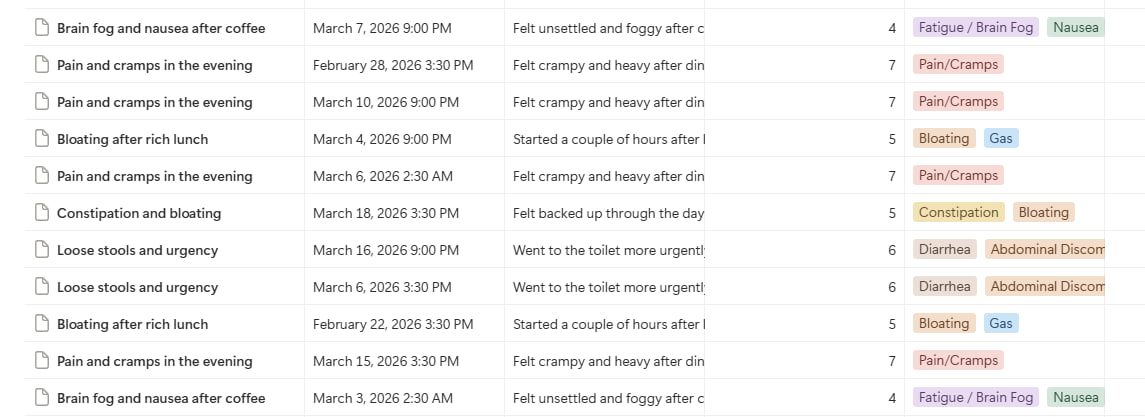
Skip the panel, run the experiment
Log meals and symptoms by voice or text, and let AI surface possible food-symptom associations worth testing carefully.
Start Tracking Free →The verdict on IgG panels
The appeal of a test that promises a clean answer in a few weeks is understandable. But IgG panels measure the wrong thing for the question most people are asking, which is whether a food may be contributing to their symptoms. A structured process using consistent tracking and, when appropriate, clinician-guided elimination and reintroduction produces more relevant evidence. It is slower, but it is honest about uncertainty and confounding. If you want a step-by-step approach, how to investigate possible food triggers walks through the process.
Food-specific IgG antibodies reflect exposure to a food, not intolerance or sensitivity to it, and some research suggests high IgG4 may even indicate tolerance. Major allergy and immunology bodies, including the AAAAI, advise against using IgG panel testing to diagnose food sensitivity. Feeling better after an IgG-guided elimination can reflect broad dietary changes, expectation effects, or chance rather than validation of the report. Careful symptom tracking and, when appropriate, clinician-guided elimination and reintroduction can provide more relevant evidence about possible food-symptom associations.
Sources
- American Academy of Allergy, Asthma & Immunology. "The Myth of IgG Food Panel Testing" (AAAAI patient education resource on IgG/IgG4 food testing and the Choosing Wisely recommendation against unproven allergy/intolerance testing)
- Mearin F, Lacy BE et al. "Bowel Disorders" (Rome IV) - Gastroenterology 2016;150:1393-1407
- Monash University FODMAP Diet - elimination and reintroduction methodology



This article is for informational purposes and is not medical advice. Talk to your doctor before making dietary changes.
Start with the free 7-Day Trigger Discovery Challenge
Not ready for the app yet? Download the printable guide and work through 7 days of structured observation, with a few practical follow-up emails to help you stay on track.
- 20-page guide delivered immediately by email
- Daily meal, symptom, and lifestyle tracking pages
- Designed to help you spot early trigger patterns without overwhelm
Free - delivered straight to your inbox
🔒 No spam, we promise. Unsubscribe any time.
Or skip straight to the app - start tracking free →
Ready to find your triggers?
Track by voice. Let AI surface possible patterns.
Log meals and symptoms in seconds. AI structures your data and surfaces possible patterns, including delayed associations worth testing.
Start Tracking Free →Free to start · $59 one-time for full insights · No subscription