
Understanding IBS
IBS-C, IBS-D, IBS-M, and IBS-U: What the Subtypes Mean
Rome IV describes four IBS subtypes based on stool form. Learn what IBS-C, IBS-D, IBS-M, and IBS-U mean, and how a diary can support a clinical discussion.


IBS can involve constipation, diarrhea, or both, but those patterns do not establish an IBS diagnosis by themselves. Under Rome IV, IBS involves recurrent abdominal pain, on average at least one day per week in the previous three months, associated with at least two of these: bowel movements, a change in stool frequency, or a change in stool form. Symptoms must have started at least six months before diagnosis. A clinician can often make a positive diagnosis from the symptom pattern and limited targeted testing rather than testing for every possible digestive condition.
Once IBS has been established, stool form can help classify it into one of four subtypes: IBS-C, IBS-D, IBS-M, or IBS-U. The subtype is mainly useful for discussing bowel-habit treatment and describing how symptoms change over time. It does not tell you which food caused a flare.
The four Rome IV subtypes
Rome IV uses the Bristol Stool Form Scale and looks at bowel movements with an abnormal stool form. Types 1 and 2 are hard or lumpy. Types 6 and 7 are loose or watery. Types 3 through 5 do not count toward either abnormal-form category used for subtyping.
- IBS-C (constipation-predominant): more than 25% of abnormal bowel movements are Bristol types 1 or 2, and fewer than 25% are types 6 or 7.
- IBS-D (diarrhea-predominant): more than 25% of abnormal bowel movements are Bristol types 6 or 7, and fewer than 25% are types 1 or 2.
- IBS-M (mixed): more than 25% are types 1 or 2, and more than 25% are types 6 or 7.
- IBS-U (unclassified): the person meets the criteria for IBS, but the stool-form pattern does not meet the thresholds for IBS-C, IBS-D, or IBS-M.
The percentages apply to bowel movements with abnormal stool form, not to every calendar day. Medicines or supplements that change bowel habits can also affect the pattern, so include them when discussing a diary with a clinician.
IBS-M does not require constipation and diarrhea to alternate on a particular schedule. Both hard or lumpy and loose or watery stools simply need to exceed the Rome IV thresholds. A new or marked change still deserves clinical review rather than being assumed to be IBS-M.
Why the subtype can matter
Subtype is useful because management often depends on the predominant bowel habit:
- Treatment choices differ. Some medicines are intended for IBS-C and others for IBS-D. Soluble fiber may help some people with IBS, while other options have different evidence and safety considerations. A clinician can match treatment to the symptom pattern and review other medicines or conditions that may be contributing.
- A flare can look different. Someone with IBS-C may focus on hard stools, straining, or infrequent bowel movements. Someone with IBS-D may focus on loose stools and urgency. A person with IBS-M may need to record both directions.
- The label can change. Research following people over time has found that some move between Rome IV subtypes. A previous label is useful history, not a guarantee that the current pattern is identical.
Subtype does not create a reliable list of food triggers. Responses to food vary, mixed meals are confounded, and the same food can be eaten without symptoms on another day. A diary can help you notice a possible association worth discussing or testing carefully, but it cannot prove causality.
Recording stool form for a clinical discussion
If IBS has already been diagnosed, or a clinician is assessing your bowel pattern, a short structured diary can be more useful than labels such as "good day" or "bad day."
- Record each bowel movement with a Bristol type. Types 1 and 2 are hard or lumpy, and types 6 and 7 are loose or watery.
- Record relevant context. Include abdominal pain, urgency, medicines, laxatives, antidiarrheals, supplements, and unusual schedule changes. These details can affect interpretation.
- Look at the distribution, not the worst episode. One loose stool in an otherwise constipation-predominant period does not by itself establish IBS-M.
- Take the record to a clinician. A diary can summarize the pattern, but it does not diagnose IBS or assign a subtype on its own.
Rome guidance for clinical studies uses at least two weeks of daily diary data to classify subtype. In ordinary care, the useful recording period depends on symptom frequency and the clinical question. Do not delay seeking care just to complete a diary.
If constipation is the dominant pattern, the IBS-C guide explains common management options and when to seek medical advice. Avoid making major dietary restrictions solely from a subtype label.
A food and symptom diary can still be useful. Treat repeated timing patterns as hypotheses, compare them with days when the same food did not precede symptoms, and involve a clinician or registered dietitian before a restrictive diet.
Summarize your bowel pattern
Log meals, symptoms, medicines, and stool form by voice or text. Find My Triggers can summarize possible timing patterns and associations for you to review, including with a clinician. It does not diagnose IBS, assign a subtype, or prove that a food caused symptoms.
Start Tracking Free →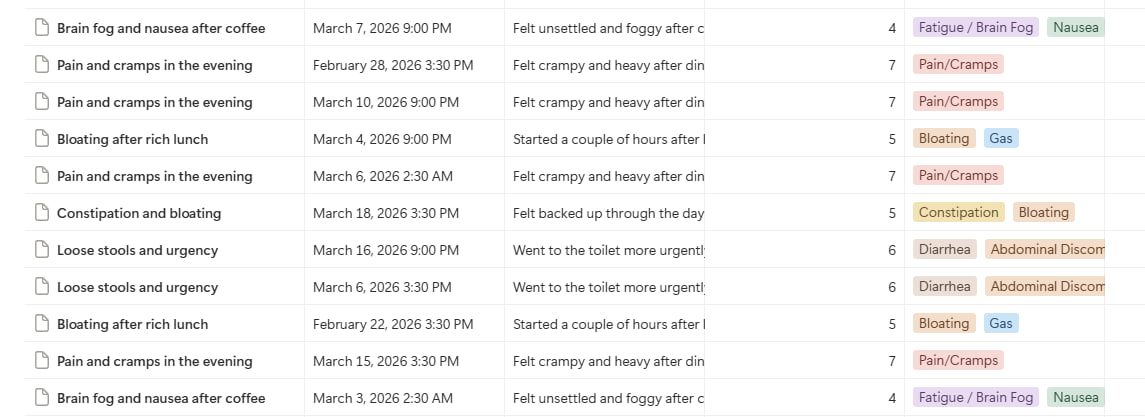
When symptoms need medical review
Subtyping is built on top of an IBS diagnosis. Constipation, diarrhea, and abdominal pain can also occur with other conditions. ACG guidance supports a positive, symptom-based approach to IBS with targeted testing where appropriate, not an assumption that every bowel change is IBS.
Arrange medical review for blood or black stool, unintentional weight loss, anemia or low iron, persistent vomiting, fever, new symptoms beginning later in life, symptoms that wake you from sleep, or a family history of inflammatory bowel disease, celiac disease, or colorectal cancer. Seek urgent care for severe or rapidly worsening symptoms.
A clinician can consider the full symptom history, medicines, family history, examination, and targeted tests. If the pattern changes substantially after an established diagnosis, it is reasonable to revisit the assessment rather than simply changing the subtype yourself.
What to remember
Rome IV describes four IBS subtypes based on stool form: IBS-C, IBS-D, IBS-M, and IBS-U. Subtype can guide a bowel-habit discussion and may change over time. It does not diagnose IBS, identify a food trigger, or replace clinical assessment. Use a diary to document the pattern and support a conversation with a clinician.
Sources
- Rome Foundation, Rome IV Diagnostic Criteria for Irritable Bowel Syndrome and its subtypes
- American College of Gastroenterology Clinical Guideline: Management of Irritable Bowel Syndrome
- NIDDK: Diagnosis of Irritable Bowel Syndrome
- NIDDK: Eating, Diet, and Nutrition for Irritable Bowel Syndrome
- Barberio B et al. Symptom Stability in Rome IV versus Rome III Irritable Bowel Syndrome



This article is for informational purposes and is not medical advice. Talk to your doctor before making dietary changes.
Start with the free 7-Day Trigger Discovery Challenge
Not ready for the app yet? Download the printable guide and work through 7 days of structured observation, with a few practical follow-up emails to help you stay on track.
- 20-page guide delivered immediately by email
- Daily meal, symptom, and lifestyle tracking pages
- Designed to help you spot early trigger patterns without overwhelm
Free - delivered straight to your inbox
🔒 No spam, we promise. Unsubscribe any time.
Or skip straight to the app - start tracking free →
Ready to find your triggers?
Track by voice. Let AI surface possible patterns.
Log meals and symptoms in seconds. AI structures your data and surfaces possible patterns, including delayed associations worth testing.
Start Tracking Free →Free to start · $59 one-time for full insights · No subscription